October 13, 2026
A hiring restriction in a supplier network may be enforced through site access, even when the company controlling the site does not employ the affected worker. Our earlier analysis explains the Biedronka decision and its penalties. This follow-up asks who makes and enforces those decisions across a supplier network.
According to Poland’s competition authority, UOKiK, carriers serving Biedronka distribution centres agreed not to compete for drivers. Jeronimo Martins Polska did not employ the affected drivers, but UOKiK found that it coordinated the arrangement, passed information between carriers and enforced restrictions through access to its sites. UOKiK reported fines totalling PLN 571,960,550 in the case, with penalties imposed on Jeronimo Martins Polska, 29 carriers and eight individuals. The decision is not final and may be appealed.
The distinction for businesses that use contractors is participation. The decision should not be read as establishing liability simply because a customer purchases services or benefits commercially from a supplier arrangement. Its own role in creating, communicating or enforcing a restriction is the issue requiring examination.
Follow the decision through the business
UOKiK describes a carrier asking Jeronimo Martins Polska to impose a waiting period on a driver. It also says the retailer prevented certain drivers who had changed carriers from entering distribution centres. Those details show why reviewing supplier contracts alone may not reveal how a restriction works.
A focused internal review can trace three stages:
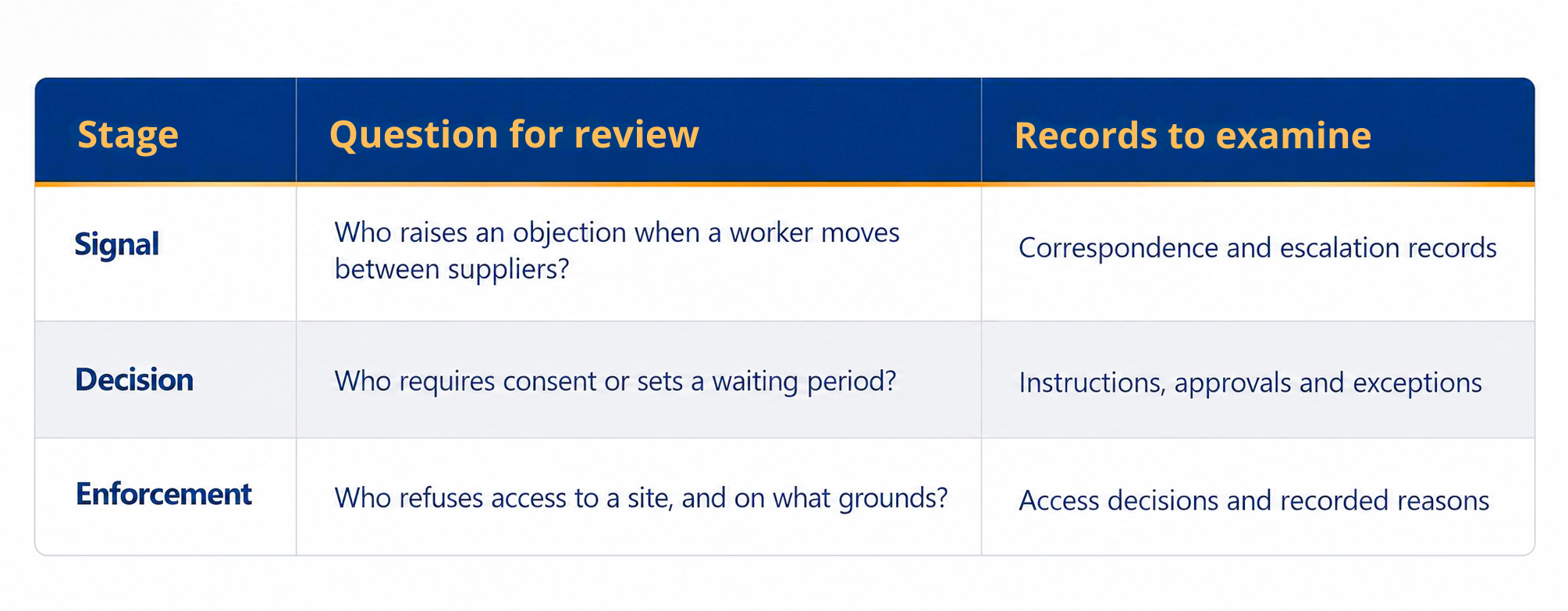
Procurement may receive the complaint, a manager may decide how to respond, and site staff may apply the decision. Management needs to understand the whole sequence, including what happens in practice when it differs from written policy.
Does a B2B contract change the analysis?
UOKiK’s explanation of its labour-market guidance makes clear that its concerns are not confined to standard employment contracts. People working under mandate contracts or through sole proprietorships may also be affected. The European Commission’s labour-market policy brief addresses service providers whose position is comparable to that of employees.
That does not make every restriction in a B2B services agreement unlawful. An individual’s contractual obligation and coordination between businesses not to recruit one another’s personnel present different legal questions. The parties, the people affected and the way the restraint operates must be examined before drawing a conclusion.
Why this matters in due diligence
A buyer examining a business that relies on contractors should look beyond template supplier agreements. Targeted due diligence may need to cover onboarding instructions, correspondence about personnel moving between suppliers and records explaining refusals of site access. Speaking with the teams that administer those processes can reveal whether the documented rules match the operating practice.
For an existing business, procurement, HR, operations and legal teams should establish who owns each stage of the review. If they identify a restriction, competition counsel should assess the arrangement and any proposed justification promptly. The European Commission’s policy brief explains that a no-poach restraint claimed to be ancillary to a legitimate transaction must meet strict conditions, including objective necessity and proportionality.
The central question is practical: who can stop a person from moving between suppliers, and what role has the principal business played in making that restriction effective?
According to Poland’s competition authority, UOKiK, carriers serving Biedronka distribution centres agreed not to compete for drivers. Jeronimo Martins Polska did not employ the affected drivers, but UOKiK found that it coordinated the arrangement, passed information between carriers and enforced restrictions through access to its sites. UOKiK reported fines totalling PLN 571,960,550 in the case, with penalties imposed on Jeronimo Martins Polska, 29 carriers and eight individuals. The decision is not final and may be appealed.
The distinction for businesses that use contractors is participation. The decision should not be read as establishing liability simply because a customer purchases services or benefits commercially from a supplier arrangement. Its own role in creating, communicating or enforcing a restriction is the issue requiring examination.
Follow the decision through the business
UOKiK describes a carrier asking Jeronimo Martins Polska to impose a waiting period on a driver. It also says the retailer prevented certain drivers who had changed carriers from entering distribution centres. Those details show why reviewing supplier contracts alone may not reveal how a restriction works.
A focused internal review can trace three stages:
Procurement may receive the complaint, a manager may decide how to respond, and site staff may apply the decision. Management needs to understand the whole sequence, including what happens in practice when it differs from written policy.
Does a B2B contract change the analysis?
UOKiK’s explanation of its labour-market guidance makes clear that its concerns are not confined to standard employment contracts. People working under mandate contracts or through sole proprietorships may also be affected. The European Commission’s labour-market policy brief addresses service providers whose position is comparable to that of employees.
That does not make every restriction in a B2B services agreement unlawful. An individual’s contractual obligation and coordination between businesses not to recruit one another’s personnel present different legal questions. The parties, the people affected and the way the restraint operates must be examined before drawing a conclusion.
Why this matters in due diligence
A buyer examining a business that relies on contractors should look beyond template supplier agreements. Targeted due diligence may need to cover onboarding instructions, correspondence about personnel moving between suppliers and records explaining refusals of site access. Speaking with the teams that administer those processes can reveal whether the documented rules match the operating practice.
For an existing business, procurement, HR, operations and legal teams should establish who owns each stage of the review. If they identify a restriction, competition counsel should assess the arrangement and any proposed justification promptly. The European Commission’s policy brief explains that a no-poach restraint claimed to be ancillary to a legitimate transaction must meet strict conditions, including objective necessity and proportionality.
The central question is practical: who can stop a person from moving between suppliers, and what role has the principal business played in making that restriction effective?
About the Author

Founder and Managing Partner
phone: +48 602 352 580
Read also

November 09, 2026
WEBINAR: “Polish Company in Limbo: Practical Steps...
A management board member in a Polish company manages and represents the entity, so inaction can leave the entity unable to sign, file, pay,...
Read more
November 09, 2026
Woźniak Legal Recognised at the European Legal Awards...
We are proud to announce that Woźniak Legal has been awarded the title of Best Cross-Border Fraud & Asset Recovery Law Firm 2026 at the...
Read more
November 02, 2026
Grzegorz E. Woźniak Discusses Asset Tracing in Risky...
On 30 October 2026, Grzegorz E. Woźniak joined Rachel Cropper-Mawer of Keidan Harrison LLP and Sam Taylor of Mintz Group as a panellist at the...
Read more