October 15, 2026
A rejected job application, a requirement for the current employer’s consent or a refusal of site access may be the only signs a worker sees of a wider hiring restriction. The Biedronka no-poach case illustrates why these individual experiences can be difficult to connect with coordination between businesses.
According to Poland’s competition authority, UOKiK, the arrangement operated from June 2017 until at least February 2024 and affected the employment conditions of several thousand drivers. The decision is not final and may be appealed.
Our earlier analysis of the decision explains UOKiK’s findings and the penalties. This article considers what an individual worker might recognise, what could remain hidden and how a concern can be raised.
The limits of an individual worker’s knowledge
In its July 2025 announcement, UOKiK used a hypothetical example to illustrate the potential consequences. A driver sought better conditions with another carrier serving the same distribution centre. Despite having the necessary qualifications and experience, his application was rejected. He later learned unofficially that an arrangement between the businesses had blocked the move.
The example captures the difficulty of recognising a wider restriction from a single recruitment experience. An unsuccessful applicant may initially question the employer’s assessment or suspect unfair treatment. Without further information, they may have little reason to connect that outcome with decisions taken by other companies.
Establishing that connection may require correspondence, instructions and evidence of how different businesses acted. An individual worker is unlikely to have access to the full record. Their account can nevertheless provide a starting point for further investigation.
How site access could restrict a job move
UOKiK found that drivers moving between participating carriers needed their employer’s consent. Without it, they could not work for another carrier at the relevant distribution centre until a waiting period, lasting several months, had expired. Jeronimo Martins Polska coordinated the arrangement and enforced restrictions through access to its sites, although it did not employ the drivers.
The authority explained that this could make hiring the driver virtually uneconomical for a competing carrier. For the worker, the restriction could reduce the practical value of a new opportunity and create uncertainty about earning a living during the transition.
A rule described as a waiting period or access requirement can therefore have consequences well beyond its administrative wording. Understanding those consequences requires asking why the rule applies and whose decision it reflects.
Warning signs worth recording
The following situations warrant questions about how a recruitment or access decision was made. None, by itself, establishes an unlawful agreement.
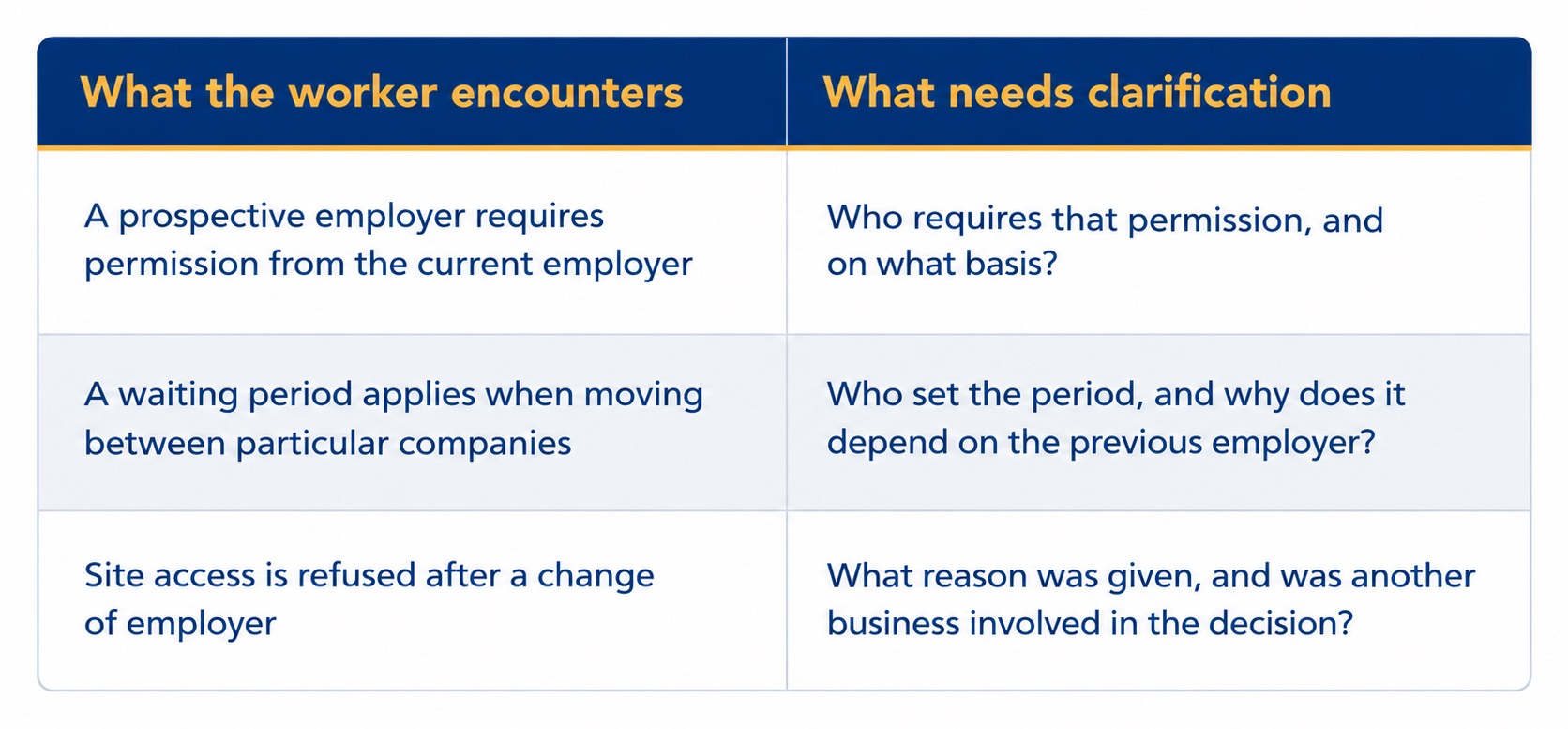
There may be legitimate explanations for a rejected application or a site-access decision. The concern becomes more specific where the explanation points to businesses agreeing who may recruit whom. A worker’s individual contractual obligations and an agreement between businesses require separate legal assessment.
Reporting suspected hiring restrictions
Difficulty seeing the wider picture should not be confused with an inability to report a concern. UOKiK’s reporting guidance asks who is involved, how competition may be restricted and where evidence might be found. It invites people to provide correspondence and other documents if they can, and offers an anonymous reporting route.
A useful account can describe what happened, when it happened, which businesses were involved and what explanation was given. Correspondence already lawfully held by the worker may help. It is also useful to distinguish what the worker directly experienced from what they were told or suspect.
The authority can then assess that information and decide whether further investigation is warranted. The worker does not need to reconstruct the entire arrangement before raising the concern.
Implications for employers
For employers, a worker’s question about a blocked move should prompt an examination of the reason behind the decision. Can the business explain its own grounds, or is it acting on another company’s objection to losing a worker?
Where the answer suggests coordination between businesses, competition counsel should assess the arrangement. Our article on no-poach risks in supplier networks examines how procurement, management and site operations can become involved, and what businesses and transaction teams should review.
Fair competition in the labour market is not an abstraction. It is the practical freedom to leave for a better wage, better conditions, or simply a different employer. When that freedom is quietly taken away, the harm is real, even if those suffering it never learn its name.
According to Poland’s competition authority, UOKiK, the arrangement operated from June 2017 until at least February 2024 and affected the employment conditions of several thousand drivers. The decision is not final and may be appealed.
Our earlier analysis of the decision explains UOKiK’s findings and the penalties. This article considers what an individual worker might recognise, what could remain hidden and how a concern can be raised.
The limits of an individual worker’s knowledge
In its July 2025 announcement, UOKiK used a hypothetical example to illustrate the potential consequences. A driver sought better conditions with another carrier serving the same distribution centre. Despite having the necessary qualifications and experience, his application was rejected. He later learned unofficially that an arrangement between the businesses had blocked the move.
The example captures the difficulty of recognising a wider restriction from a single recruitment experience. An unsuccessful applicant may initially question the employer’s assessment or suspect unfair treatment. Without further information, they may have little reason to connect that outcome with decisions taken by other companies.
Establishing that connection may require correspondence, instructions and evidence of how different businesses acted. An individual worker is unlikely to have access to the full record. Their account can nevertheless provide a starting point for further investigation.
How site access could restrict a job move
UOKiK found that drivers moving between participating carriers needed their employer’s consent. Without it, they could not work for another carrier at the relevant distribution centre until a waiting period, lasting several months, had expired. Jeronimo Martins Polska coordinated the arrangement and enforced restrictions through access to its sites, although it did not employ the drivers.
The authority explained that this could make hiring the driver virtually uneconomical for a competing carrier. For the worker, the restriction could reduce the practical value of a new opportunity and create uncertainty about earning a living during the transition.
A rule described as a waiting period or access requirement can therefore have consequences well beyond its administrative wording. Understanding those consequences requires asking why the rule applies and whose decision it reflects.
Warning signs worth recording
The following situations warrant questions about how a recruitment or access decision was made. None, by itself, establishes an unlawful agreement.
There may be legitimate explanations for a rejected application or a site-access decision. The concern becomes more specific where the explanation points to businesses agreeing who may recruit whom. A worker’s individual contractual obligations and an agreement between businesses require separate legal assessment.
Reporting suspected hiring restrictions
Difficulty seeing the wider picture should not be confused with an inability to report a concern. UOKiK’s reporting guidance asks who is involved, how competition may be restricted and where evidence might be found. It invites people to provide correspondence and other documents if they can, and offers an anonymous reporting route.
A useful account can describe what happened, when it happened, which businesses were involved and what explanation was given. Correspondence already lawfully held by the worker may help. It is also useful to distinguish what the worker directly experienced from what they were told or suspect.
The authority can then assess that information and decide whether further investigation is warranted. The worker does not need to reconstruct the entire arrangement before raising the concern.
Implications for employers
For employers, a worker’s question about a blocked move should prompt an examination of the reason behind the decision. Can the business explain its own grounds, or is it acting on another company’s objection to losing a worker?
Where the answer suggests coordination between businesses, competition counsel should assess the arrangement. Our article on no-poach risks in supplier networks examines how procurement, management and site operations can become involved, and what businesses and transaction teams should review.
Fair competition in the labour market is not an abstraction. It is the practical freedom to leave for a better wage, better conditions, or simply a different employer. When that freedom is quietly taken away, the harm is real, even if those suffering it never learn its name.
About the Author

Founder and Managing Partner
phone: +48 602 352 580
Read also

November 09, 2026
WEBINAR: “Polish Company in Limbo: Practical Steps...
A management board member in a Polish company manages and represents the entity, so inaction can leave the entity unable to sign, file, pay,...
Read more
November 09, 2026
Woźniak Legal Recognised at the European Legal Awards...
We are proud to announce that Woźniak Legal has been awarded the title of Best Cross-Border Fraud & Asset Recovery Law Firm 2026 at the...
Read more
November 02, 2026
Grzegorz E. Woźniak Discusses Asset Tracing in Risky...
On 30 October 2026, Grzegorz E. Woźniak joined Rachel Cropper-Mawer of Keidan Harrison LLP and Sam Taylor of Mintz Group as a panellist at the...
Read more