October 23, 2026
Paying the purchase price and updating company records do not, by themselves, establish that shares have been validly transferred. When a defect emerges in a Polish limited liability company (sp. z o.o.), the first question is which legal requirement was missed.
A failure to observe the statutory form can mean that no title passed. Missing company consent presents a different problem and may be addressed through subsequent approval. Failure to notify the company concerns when an otherwise effective transfer becomes effective towards the company.
These distinctions determine what can be corrected, by whom and with what effect.
Our earlier article on invalid share transfers explains why a defect requires active attention. This article examines how the remedy depends on its cause.
Different defects require different remedies
The following comparison assumes that the identified defect is the only obstacle to the transfer.
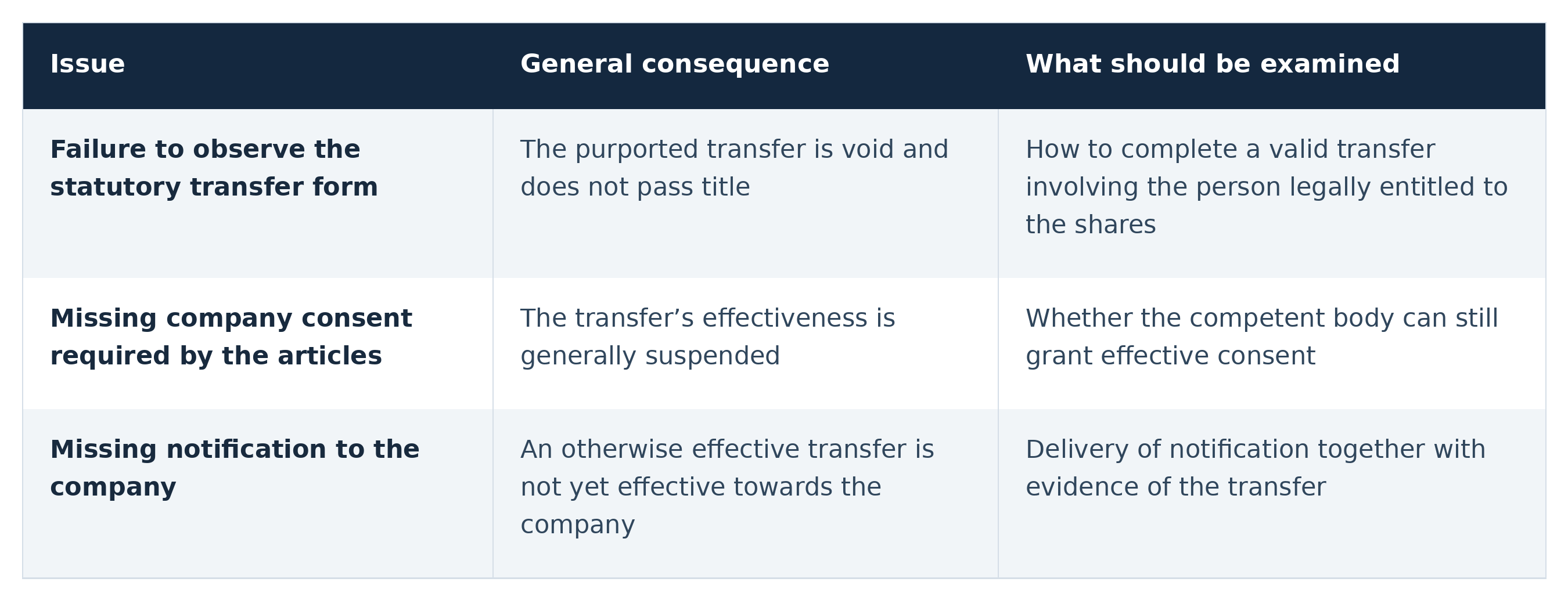
A document described as a “confirmation” will not necessarily resolve all three situations. Its legal effect depends on its substance and the underlying defect.
The statutory form requirement
Under Article 180 § 1 of the Commercial Companies Code, a transfer of shares generally requires writing with signatures certified by a notary. This is distinct from requiring the entire agreement to take the form of a notarial deed.
Article 180 § 2 provides an alternative for companies whose articles were concluded using the statutory template. The transfer can use the prescribed template in the electronic system, with qualified electronic signatures, trusted signatures or personal signatures associated with the Polish electronic identity card.
This is a specific statutory route. Signing an ordinary PDF electronically outside that process should not be assumed to satisfy the transfer requirements.
The form assessment also requires attention to what a document actually does. A separate settlement concerning transaction-related claims does not automatically become a share transfer merely because it relates to the same acquisition. However, amendments to the transaction documents may engage statutory or contractually agreed form requirements and need their own assessment.
A form defect generally requires a valid transfer
Article 180 must be read alongside Article 73 § 2 of the Civil Code, which addresses failure to observe a prescribed special form. Where the required share-transfer form has not been observed, the purported transfer is void. Payment of the price does not substitute for that form.
The practical response commonly involves executing a valid transfer in the required form. Crucially, the transferor must be legally entitled to dispose of the shares.
A subsequent agreement does not ordinarily make a form-defective transfer valid from its original date. Nor does calling a document a “ratification” or assigning it an earlier date achieve that result. Any corrective document must be assessed for what it legally accomplishes and when title actually passes.
The parties must also address the commercial consequences. These may include payments already made, dividends received and decisions taken while the buyer was treated as a shareholder. Correcting title does not automatically resolve those separate issues.
Missing company consent is a different problem
Article 182 of the Commercial Companies Code permits the articles of association to make a transfer conditional on company consent or impose other restrictions.
Where company consent is required, the statutory default is written consent from the management board. The articles may provide a different arrangement, including assigning the decision to another corporate body. The applicable decision-making and representation requirements must therefore be checked rather than assumed.
Under the default statutory procedure, if consent is refused, the registry court may permit the transfer where important grounds exist. The articles must be reviewed because Article 182 allows departures from that procedure.
A transfer made without the required company consent is generally treated as subject to suspended effectiveness. This concerns the relationship between the parties as well as the position towards the company. The Supreme Court explained that distinction in its judgment of 29 August 2013 in case I CSK 713/12.
Subsequent consent can therefore matter in a way that subsequent approval of a form-defective transfer generally cannot. Article 63 § 1 of the Civil Code provides that a third party’s consent may be given after the relevant declaration and, when validly given, has retrospective effect.
That does not mean consent can always be supplied indefinitely. The articles, transaction terms, any refusal, applicable deadlines and intervening events require examination before concluding that later approval remains available and effective.
Other restrictions, including pre-emption arrangements or statutory authorisations, require separate analysis. Their consequences should not automatically be equated with missing company consent.
Notification affects the position towards the company
Article 187 § 1 addresses a separate step: notifying the company and providing evidence of the transfer.
An otherwise effective transfer becomes effective towards the company when it receives the required notification and evidence from one of the interested parties. Missing notification therefore differs from failing to acquire title in the first place.
The practical response is to deliver the necessary material and address the resulting corporate records. Notification cannot, however, turn a void transfer into a valid one.
Due diligence must trace the chain of title
A defect may sit several transactions behind the proposed seller. A later agreement executed in the correct form does not, by itself, establish that the seller acquired the shares under an earlier transaction.
As our analysis of ownership checks and the National Court Register explains, register information must be checked against the underlying acquisition documents. Recording someone as a shareholder does not itself cure a defective acquisition.
A focused review should establish:
Different acquisition routes, including inheritance and corporate reorganisations, require the documents and rules appropriate to them.
If a break appears, the remedial plan must identify the person currently entitled to the shares. It should also address affected contractual arrangements and corporate actions. Re-signing the latest agreement alone may leave the underlying problem unresolved.
Start with the defect before choosing the remedy
The useful question is not simply whether a defective transfer can be “validated”. It is whether the problem concerns statutory form, required consent, notification or the transferor’s title.
That diagnosis determines whether the next step is a valid new transfer, subsequent approval, notification or a more extensive reconstruction of ownership.
Woźniak Legal’s Corporate and M&A team advises on share acquisitions, title verification, corporate approvals and transaction documentation. Reviewing a suspected defect before completion can help establish what must be resolved and how it affects the proposed transaction.
A failure to observe the statutory form can mean that no title passed. Missing company consent presents a different problem and may be addressed through subsequent approval. Failure to notify the company concerns when an otherwise effective transfer becomes effective towards the company.
These distinctions determine what can be corrected, by whom and with what effect.
Our earlier article on invalid share transfers explains why a defect requires active attention. This article examines how the remedy depends on its cause.
Different defects require different remedies
The following comparison assumes that the identified defect is the only obstacle to the transfer.
A document described as a “confirmation” will not necessarily resolve all three situations. Its legal effect depends on its substance and the underlying defect.
The statutory form requirement
Under Article 180 § 1 of the Commercial Companies Code, a transfer of shares generally requires writing with signatures certified by a notary. This is distinct from requiring the entire agreement to take the form of a notarial deed.
Article 180 § 2 provides an alternative for companies whose articles were concluded using the statutory template. The transfer can use the prescribed template in the electronic system, with qualified electronic signatures, trusted signatures or personal signatures associated with the Polish electronic identity card.
This is a specific statutory route. Signing an ordinary PDF electronically outside that process should not be assumed to satisfy the transfer requirements.
The form assessment also requires attention to what a document actually does. A separate settlement concerning transaction-related claims does not automatically become a share transfer merely because it relates to the same acquisition. However, amendments to the transaction documents may engage statutory or contractually agreed form requirements and need their own assessment.
A form defect generally requires a valid transfer
Article 180 must be read alongside Article 73 § 2 of the Civil Code, which addresses failure to observe a prescribed special form. Where the required share-transfer form has not been observed, the purported transfer is void. Payment of the price does not substitute for that form.
The practical response commonly involves executing a valid transfer in the required form. Crucially, the transferor must be legally entitled to dispose of the shares.
A subsequent agreement does not ordinarily make a form-defective transfer valid from its original date. Nor does calling a document a “ratification” or assigning it an earlier date achieve that result. Any corrective document must be assessed for what it legally accomplishes and when title actually passes.
The parties must also address the commercial consequences. These may include payments already made, dividends received and decisions taken while the buyer was treated as a shareholder. Correcting title does not automatically resolve those separate issues.
Missing company consent is a different problem
Article 182 of the Commercial Companies Code permits the articles of association to make a transfer conditional on company consent or impose other restrictions.
Where company consent is required, the statutory default is written consent from the management board. The articles may provide a different arrangement, including assigning the decision to another corporate body. The applicable decision-making and representation requirements must therefore be checked rather than assumed.
Under the default statutory procedure, if consent is refused, the registry court may permit the transfer where important grounds exist. The articles must be reviewed because Article 182 allows departures from that procedure.
A transfer made without the required company consent is generally treated as subject to suspended effectiveness. This concerns the relationship between the parties as well as the position towards the company. The Supreme Court explained that distinction in its judgment of 29 August 2013 in case I CSK 713/12.
Subsequent consent can therefore matter in a way that subsequent approval of a form-defective transfer generally cannot. Article 63 § 1 of the Civil Code provides that a third party’s consent may be given after the relevant declaration and, when validly given, has retrospective effect.
That does not mean consent can always be supplied indefinitely. The articles, transaction terms, any refusal, applicable deadlines and intervening events require examination before concluding that later approval remains available and effective.
Other restrictions, including pre-emption arrangements or statutory authorisations, require separate analysis. Their consequences should not automatically be equated with missing company consent.
Notification affects the position towards the company
Article 187 § 1 addresses a separate step: notifying the company and providing evidence of the transfer.
An otherwise effective transfer becomes effective towards the company when it receives the required notification and evidence from one of the interested parties. Missing notification therefore differs from failing to acquire title in the first place.
The practical response is to deliver the necessary material and address the resulting corporate records. Notification cannot, however, turn a void transfer into a valid one.
Due diligence must trace the chain of title
A defect may sit several transactions behind the proposed seller. A later agreement executed in the correct form does not, by itself, establish that the seller acquired the shares under an earlier transaction.
As our analysis of ownership checks and the National Court Register explains, register information must be checked against the underlying acquisition documents. Recording someone as a shareholder does not itself cure a defective acquisition.
A focused review should establish:
- how the shares were originally created and acquired;
- which articles and transfer restrictions applied at each relevant date;
- whether each acquisition met the requirements applicable to it;
- whether the necessary consents, waivers and authorisations were obtained;
- whether notification and company records accurately reflect the legal position.
Different acquisition routes, including inheritance and corporate reorganisations, require the documents and rules appropriate to them.
If a break appears, the remedial plan must identify the person currently entitled to the shares. It should also address affected contractual arrangements and corporate actions. Re-signing the latest agreement alone may leave the underlying problem unresolved.
Start with the defect before choosing the remedy
The useful question is not simply whether a defective transfer can be “validated”. It is whether the problem concerns statutory form, required consent, notification or the transferor’s title.
That diagnosis determines whether the next step is a valid new transfer, subsequent approval, notification or a more extensive reconstruction of ownership.
Woźniak Legal’s Corporate and M&A team advises on share acquisitions, title verification, corporate approvals and transaction documentation. Reviewing a suspected defect before completion can help establish what must be resolved and how it affects the proposed transaction.
About the Author

Founder and Managing Partner
phone: +48 602 352 580
Read also

November 09, 2026
WEBINAR: “Polish Company in Limbo: Practical Steps...
A management board member in a Polish company manages and represents the entity, so inaction can leave the entity unable to sign, file, pay,...
Read more
November 09, 2026
Woźniak Legal Recognised at the European Legal Awards...
We are proud to announce that Woźniak Legal has been awarded the title of Best Cross-Border Fraud & Asset Recovery Law Firm 2026 at the...
Read more
November 02, 2026
Grzegorz E. Woźniak Discusses Asset Tracing in Risky...
On 30 October 2026, Grzegorz E. Woźniak joined Rachel Cropper-Mawer of Keidan Harrison LLP and Sam Taylor of Mintz Group as a panellist at the...
Read more