October 21, 2026
Two businesses may sell entirely different products and still compete for the same employees. A manufacturer and a retailer, for example, may both recruit drivers, warehouse staff or IT specialists. Agreements about those workers can therefore raise competition concerns even when the businesses do not compete for customers.
Our analysis of the Biedronka no-poach decision examined one example of restrictions on recruitment. The wider principle applies to decisions about compensation and the information employers share.
Article 6 of Poland’s Competition and Consumer Protection Act prohibits agreements whose object or effect is to restrict competition on a relevant market. Article 101 TFEU may also apply where an arrangement may affect trade between EU Member States.
The following table summarises three areas employers should examine when reviewing their hiring and pay practices.
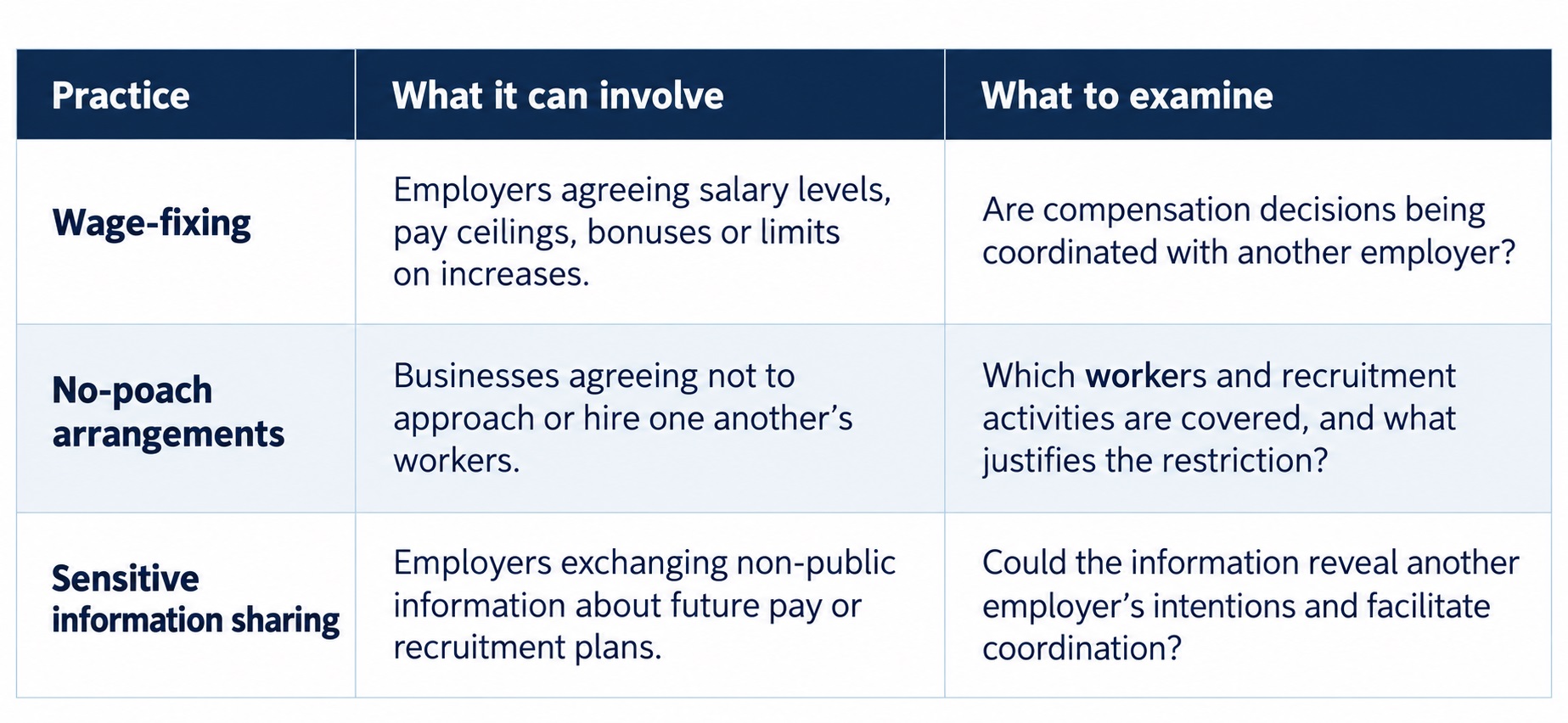
These examples identify issues requiring review. The assessment depends on the particular arrangement, including how information is shared and whether a recruitment restriction has a legally supportable justification.
Wage-fixing extends beyond basic salary
Wage-fixing occurs when businesses coordinate the compensation they offer workers. It may involve agreed salary levels, pay ceilings, bonuses or decisions not to grant increases.
An agreement to keep pay for a category of workers below a particular amount can remove the pressure that would otherwise arise when employers compete to attract or retain staff. Describing that arrangement as controlling costs does not remove the competition concern.
UOKiK’s explanation of its labour-market guidance identifies coordinated salary caps and agreements not to grant increases as prohibited practices. Coordination concerning other working conditions, such as the number of remote-working days, may also restrict competition.
A formal contract is unnecessary. Informal understandings between HR managers or other representatives of competing employers can also create exposure.
No-poach agreements restrict recruitment
No-poach arrangements concern whether businesses will recruit one another’s workers. They may prohibit hiring altogether or prevent employers from actively approaching another business’s staff.
A restriction on active recruitment can raise competition concerns even where workers remain free to apply independently. A broader arrangement may also prevent an employer from considering an unsolicited application. Such restrictions can concern named individuals or categories of workers.
Restrictions may operate through consent requirements, waiting periods or site-access instructions. Our article on no-poach risks in supplier networks explains why reviewing contractual wording alone may miss how a restriction works in practice.
A recruitment restriction connected with a legitimate transaction or cooperation requires a specific assessment. The European Commission’s labour-market policy brief explains that an ancillary restraint must meet strict conditions, including objective necessity and proportionality. Including a clause in a business sale or cooperation agreement does not itself establish that those conditions are met.
Sharing sensitive information creates a separate risk
An agreement to fix wages and an exchange of information about wages require distinct analysis. Sharing commercially sensitive information can create competition risk even without an express agreement about future pay.
Particular care is needed with non-public information about planned salary increases, future pay ranges, bonuses or recruitment intentions. An exchange may reduce uncertainty about another employer’s conduct and facilitate coordination.
The assessment depends on the information’s detail, age and commercial relevance, who receives it and how it can be used. The European Commission’s Horizontal Guidelines provide the broader framework for examining these exchanges.
Salary benchmarking therefore requires careful design. Historical, aggregated information may present lower risk than identifiable data about individual employers’ current or future plans. A consultant or industry association does not automatically make an exchange lawful.
Before participating, a business should understand what contributors disclose, what participants receive and whether individual employers or their plans can be identified from the results.
What employers should review
Competition compliance should extend to the people who make recruitment and compensation decisions. A focused review can ask:
These concerns can also affect people engaged under civil-law contracts or through sole proprietorships. An individual worker’s contractual obligations and coordination between businesses require separate legal assessment.
Where a review identifies a concern, the business should preserve relevant records and obtain competition-law advice promptly.
The central question is whether recruitment and compensation decisions are made independently or coordinated with another undertaking. Examining that question alongside employment-law compliance can help businesses identify risks before an informal understanding becomes established practice.
Woźniak Legal’s competition team advises on anti-competitive agreements, compliance reviews and investigations, including arrangements concerning recruitment and exchanges of sensitive information.
Our analysis of the Biedronka no-poach decision examined one example of restrictions on recruitment. The wider principle applies to decisions about compensation and the information employers share.
Article 6 of Poland’s Competition and Consumer Protection Act prohibits agreements whose object or effect is to restrict competition on a relevant market. Article 101 TFEU may also apply where an arrangement may affect trade between EU Member States.
The following table summarises three areas employers should examine when reviewing their hiring and pay practices.
These examples identify issues requiring review. The assessment depends on the particular arrangement, including how information is shared and whether a recruitment restriction has a legally supportable justification.
Wage-fixing extends beyond basic salary
Wage-fixing occurs when businesses coordinate the compensation they offer workers. It may involve agreed salary levels, pay ceilings, bonuses or decisions not to grant increases.
An agreement to keep pay for a category of workers below a particular amount can remove the pressure that would otherwise arise when employers compete to attract or retain staff. Describing that arrangement as controlling costs does not remove the competition concern.
UOKiK’s explanation of its labour-market guidance identifies coordinated salary caps and agreements not to grant increases as prohibited practices. Coordination concerning other working conditions, such as the number of remote-working days, may also restrict competition.
A formal contract is unnecessary. Informal understandings between HR managers or other representatives of competing employers can also create exposure.
No-poach agreements restrict recruitment
No-poach arrangements concern whether businesses will recruit one another’s workers. They may prohibit hiring altogether or prevent employers from actively approaching another business’s staff.
A restriction on active recruitment can raise competition concerns even where workers remain free to apply independently. A broader arrangement may also prevent an employer from considering an unsolicited application. Such restrictions can concern named individuals or categories of workers.
Restrictions may operate through consent requirements, waiting periods or site-access instructions. Our article on no-poach risks in supplier networks explains why reviewing contractual wording alone may miss how a restriction works in practice.
A recruitment restriction connected with a legitimate transaction or cooperation requires a specific assessment. The European Commission’s labour-market policy brief explains that an ancillary restraint must meet strict conditions, including objective necessity and proportionality. Including a clause in a business sale or cooperation agreement does not itself establish that those conditions are met.
Sharing sensitive information creates a separate risk
An agreement to fix wages and an exchange of information about wages require distinct analysis. Sharing commercially sensitive information can create competition risk even without an express agreement about future pay.
Particular care is needed with non-public information about planned salary increases, future pay ranges, bonuses or recruitment intentions. An exchange may reduce uncertainty about another employer’s conduct and facilitate coordination.
The assessment depends on the information’s detail, age and commercial relevance, who receives it and how it can be used. The European Commission’s Horizontal Guidelines provide the broader framework for examining these exchanges.
Salary benchmarking therefore requires careful design. Historical, aggregated information may present lower risk than identifiable data about individual employers’ current or future plans. A consultant or industry association does not automatically make an exchange lawful.
Before participating, a business should understand what contributors disclose, what participants receive and whether individual employers or their plans can be identified from the results.
What employers should review
Competition compliance should extend to the people who make recruitment and compensation decisions. A focused review can ask:
- Are proposed pay changes discussed with other employers?
- Do contracts or informal understandings restrict recruitment from another business?
- What information is shared through salary surveys, HR networks or industry meetings?
- Do staff know how to escalate a request to coordinate pay or hiring?
These concerns can also affect people engaged under civil-law contracts or through sole proprietorships. An individual worker’s contractual obligations and coordination between businesses require separate legal assessment.
Where a review identifies a concern, the business should preserve relevant records and obtain competition-law advice promptly.
The central question is whether recruitment and compensation decisions are made independently or coordinated with another undertaking. Examining that question alongside employment-law compliance can help businesses identify risks before an informal understanding becomes established practice.
Woźniak Legal’s competition team advises on anti-competitive agreements, compliance reviews and investigations, including arrangements concerning recruitment and exchanges of sensitive information.
About the Author

Founder and Managing Partner
phone: +48 602 352 580
Read also

November 09, 2026
WEBINAR: “Polish Company in Limbo: Practical Steps...
A management board member in a Polish company manages and represents the entity, so inaction can leave the entity unable to sign, file, pay,...
Read more
November 09, 2026
Woźniak Legal Recognised at the European Legal Awards...
We are proud to announce that Woźniak Legal has been awarded the title of Best Cross-Border Fraud & Asset Recovery Law Firm 2026 at the...
Read more
November 02, 2026
Grzegorz E. Woźniak Discusses Asset Tracing in Risky...
On 30 October 2026, Grzegorz E. Woźniak joined Rachel Cropper-Mawer of Keidan Harrison LLP and Sam Taylor of Mintz Group as a panellist at the...
Read more